
Savage Words: Sometimes, game stories are difficult to write
I’ve probably written – and I’m not exaggerating here – probably a thousand game stories over the last three decades.
From football, basketball, hockey, soccer, volleyball, softball and baseball, I’ve put a few words on paper.
Some are quite easy to write. They kind of write themselves. I feel like I’ve written the same game story a thousand different times – there’s a lede, some beefy stuff in the middle of what happened, and an ending to tie it up. Throw some quotes in there, and you’re at 700 words fairly quickly.
But some … some are difficult to crank out.
Surprisingly, blowouts can be a challenge. Nothing flows, and I get hung up on blowouts quite often. Another difficult one is extremely tight games, when the lead changes a lot in the final minutes. The other night I covered Iowa State vs. Memphis men’s basketball for the Associated Press. That baby went back-and-forth down the stretch, and I had two stories going at the same time. The AP insists on getting the story quickly, like NOW, so you have to have two stories going at once. When the final buzzer sounds, you ditch one of them, tighten up the other one, and get it to New York asap.
The final one that sometimes provides a real challenge is when you have to write about a loss about a team that you cover all season long. You build relationships, you know the cast of characters in the game, and it’s hard seeing the pain when it all comes to an end. The pain is evident, and it gushes out when the realization that’s all over sets in.
You know, like Friday at Howard Wood Field.
Friday was hard, down on the field, waiting to talk to players and coaches for a story I had to write. There were tears – there’s always tears. It’s actually kind of strange seeing these massive football players who deliver bone-crushing hits on opponents all season long, reduced to tears after a loss like Friday. But they did, and I understand it.
I never played one down of competitive football in high school. Not one. But I stood on the 39-yard line on Friday night, minutes after Brandon Valley’s loss to Lincoln in the state semi-finals. I considered myself fortunate, watching hugs, tears, emotions of every sort. I stood and waited for some of those emotions to subside before I started asking questions.
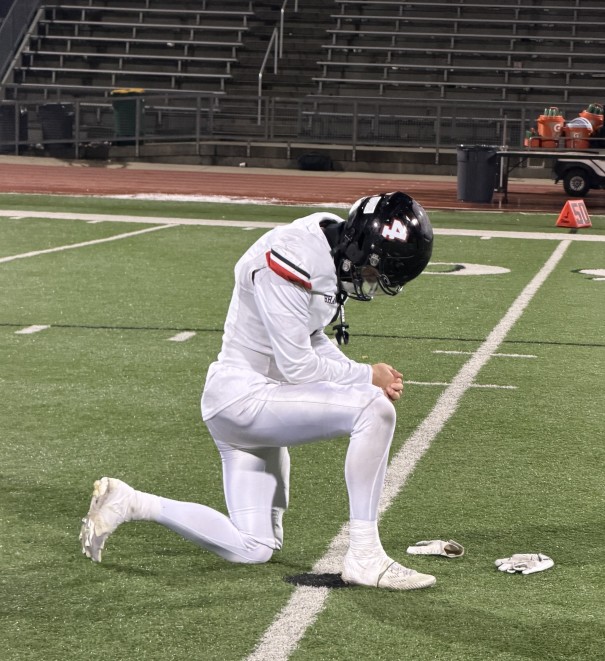
I looked to my side, and saw Lynx safety Gavin Johnson on his knees.
He got up, and I moseyed over.
“What were you doing right there,” I asked him.
“Praying,” he said.
“Really,” I said. I could have probably done better than that. “What do you think?”
“I’m always praying to God for the wins,” he said. “But you gotta pray to God for the losses as well.”
Wow.
That knocked me back for a second. I’m not the most religious man, but clearly a higher power has made an impact on that 18-year-old. He also told me that he prayed in thanks for staying injury-free all season.
I left Johnson with his thoughts, and headed towards head coach Matt Christensen. That’s where I stood on the 39, watching him deliver a multitude of hugs.
He then saw me and a few other media members, standing, waiting. When he saw us, he immediately made his way over.
He says this every time after a game, win or lose. Every time.
“Hi guys, thanks for coming. Thanks for covering us,” he said again on Friday.
Very few coaches – if any – have ever done that following a loss. It’s normally a tricky moment as you slowly navigate your way through some hard, probably stupid, questions.
“Anybody can be as hard on me as they want,” he said when asked about his decision to kick a field goal in overtime rather than going for it on fourth down for a more comfortable six-point lead. “I’ll be harder on myself than anybody by far.”
Coach, I don’t think you need to worry about people being hard on you. You’ve shown nothing but class and grace since taking over that position five years ago, and under some difficult circumstances.
After about a five-minute interview session with a bunch of us fire questions at him, it finally broke, and Christensen returned to his team, his players, his assistant coaches.
But before he left us completely, he turned back towards us.
“Thank you again,” he said. “You’re class acts all around.”
Back at ya, coach.

