
District 2 candidates answer questions unanswered at forum
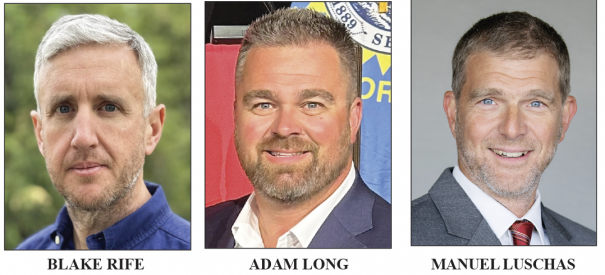
Three candidates – Democrat Blake Rife and Republicans Adam Long and Manuel Luschas – are vying for one of the two District 2 House of Representative chairs up for grabs in the Nov. 3 General election.
Questions that had been submitted by the public and prepared by the Brandon Valleuy Area Chamber of Commerce and the Brandon Valley Journal intended to be asked at the Oct. 10 forum, which did not take place as scheduled, were sent to the candidates. Following are their responses. Due to the length of the responses submitted by Luschas, they have been edited for space reasons. Luschas’s full responses can be read on our website, brandonvalleyjournal.com.
BLAKE RIFE
Please share your current or past involvement in the communities that you would represent in District 2?
I would love to say that I am lifelong resident of Sioux Falls but that would be inaccurate. I initially moved to Sioux Falls to attend what is now Augustana University for my first undergraduate degree. While living in South Dakota I have felt more comfortable here than Sioux City, Iowa (where I grew up), and Northeast Nebraska where I ranched for a decade. Post graduate education I lived in Springfield and taught in Tyndall, S.D., where I was happy to be the odd man out in a small community. While living in Sioux Falls. I got a great taste of the benefits of living in South Dakota. I have trained dogs out at the Sioux Valley Retriever Club, hunted the prairie pot holes of the I-29 corridor, hiked the Black Hills and fished all over this great state. The best part of South Dakota, outside the people, is the outdoor life it has to offer.
We are set up to entice people from all over the country with our down-home feel, outdoor opportunities, favorable business environment, and a growing base of consumers for development. Truth is we can serve as a model of prosperity across the nation because we offer something that no other state does – great people and places.
The only way we are going to get where we need to go on this, is if we are effective at inviting people into our towns to provide some competition. Capitalism thrives on competition. The reason our nation is as great as it is today is because all of the people that immigrated here joined in for a healthy competition of ideas and economics. In order for that growth to keep going we need to maintain a healthy, even playing field so everyone has the opportunity to participate.
What led you to seek a candidacy?
Literally no one else from my party signed up.
I am sick of every race being uncontested. There is no diversity of perspective. It is our duty as participants in democracy to stand up and participate in the electoral and governance process. Government relies on you to be involved. Government, in this country, is made by you. Silence means approval.
Right now. the people of District 2 have the option of two MAGA republicans or the token Democrat. Honestly, I am kind of sad for us. The MAGA version of the Republican Party does not represent the version of the party I am most comfortable with. I would beg on my knees for a Bush or McCain to stand up right now and run for office in our district. I did not like the second Bush presidency but he had a version of America he sought to try and make right, a lot of bad advisors though.
The MAGA version of the Republican Party does not stand for anything other than tearing it all down. Whether we are talking about the capital building or the foundation of disease prevention, vaccinations. They are promoting a version of capitalism where the weak are preyed upon and the strong stay there even if they have no intention of competing in the marketplace.
What SD Governor candidate do you most align with, and why?
Dan Ahlers. I have spoken with him a couple of times and I have been impressed with his genuine care for the outcomes of South Dakotans. He is a thoughtful guy that wants capitalism to compete.
If elected, what are your priorities?
As a former teacher – education. The best resource we have to get people prepared to participate in the workforce and understand the dynamics of any topics is education. There are no simple solutions to complex problems. For as much as we all want an easy answer to any problem the world is more detailed than we want it to be. In order for our young South Dakotans to stay here, do work, and grow a family there has to be opportunities that only a high-quality education can provide.
As a nurse – high-quality health outcomes. With the amount of rural citizens we have in the state an accident can be financially and personally detrimental. For those of us that live further from care primary prevention is a first line agent for longevity and a life free of the pain that being sick can cause. If you are dealing with a trauma or other acute illness – time is tissue. Keeping rural access hospitals open so health care professionals can better triage rural South Dakotans is important for everyone.
Next, AFFORDABILITY. The only way we can tackle this issue is supporting small businesses, driving innovation through investment, and decreasing our reliance on a small set of buyers for our products. If you are a farmer or rancher in South Dakota, I bet you can count on the one hand that got caught in the PTO how many different buyers you have for the products you raise. I know you can list all three. That doesn’t sound like competition to me – that sounds like oligarchy.
While door knocking, what are the issues you are hearing are on people’s minds?
Data centers, flock cameras, affordability, and individual rights.
I have not found anyone that wants data centers or flock cameras yet. I certainly do not.
With diesel being $6 (per gallon) everyone is scratching their heads wondering how we are going to move goods from place to place. Red diesel isn’t the answer to any problem, it is only going to increase demand and limit supply to farmers, who actually need it for production.
The world is topsy turvy because we have allowed ourselves to over rely on centralized production of goods. South Dakota has to compete for its space by inviting more businesses and people in, creating an environment where everyone can compete, and giving all of us the opportunity to participate in the system.
Do you feel homeowners are strugging with property tax payments?
Yes, in part because of the general affordability issues that surround the national economy.
The state and local communities need the money to fund education. Part of the reason we have the affordability issues surrounding housing though is a restriction in supply, lack of innovation, and a burden of expenses stemming from centralized production and extreme transportation and development cost.
I openly admit that every year my property tax liability makes me want to choke. However, complex situations demand complex answers. Do your property taxes go up every year or do your health insurance and car insurance premiums? Did your grocery bill go up last year and the year before that? Did your proficiency at your job go up but your wages stagnate? I bet that made you want to come back to work for another day.
Republicans will tell us that government is the problem over and over but the reality is without an effective government nothing gets better. The pundits will tell you it is the neighbor on SNAP benefits that is sucking all the money out of the system but the fat cats on Wall Street keep pulling a bigger and bigger share.
As you likely know, a plan for property tax relief has been put into place. Do you support this and if so, how do you balance this relief with the likelihood of a shortfall being made up by those who rent?
I would defer to the previous question.
Are you a proponent or opponent of Amendment I, and why? This is an amendment to the SD Constitution that repeals expanded Medicaid coverage that South Dakota voters approved when they voted on Amendment D in 2022 if federal funding for the program drops below 90%.
No one deserves to be sick. Even if they are sick because “of their own decisions” being sick isn’t anything I would wish on anyone. Truth is no one can go back to work if they are sick and we need people participating in commerce. The cost of care is out of sight, even for people with higher income levels. Nothing is more crippling that a hospital bill that is tough to pay and an insurance company that will not cover what they magically decide is not part of the coverage package.
Do you support a one-year moratorium on data centers?
I support data centers paying their own way, complying with regulations the legislative branch creates to protect property values, noise pollution, energy and water consumption and pollution. Gifting data centers tax breaks and freedom to put whatever they want wherever they want sounds like corporate welfare to me.
Do you support the use of Flock cameras in SD?
No. Absolutely not. There is an expectation of privacy and flock cameras infringe on that expectation.
Where do you stand on abortion? Do you support legalizing abortion in SD?
The right to privacy is real. I am unapologetic in my position that government should not legislate what they cannot enforce. Just because conservatives manage to pack the court with activist judges does not mean a fundamental human right can be wiped off the constitution.
A recent proposed law in the Legislature prohibits employers and schools from requiring genetic based vaccinations. Would you vote for or against this law?
The best vehicle we have to prevent viral disease is vaccinations. This recent trend to stop vaccinations is ridiculous. I get vaccinated, my kids get vaccinated, my wife and family get vaccinated. I don’t want them getting sick or worse dead. I have had to stand by and watch too many people die already. It is the most heart wrenching thing I have ever had to do in a personal or professional capacity, looking into the eyes of a loved one and tell them their family member is dead. I could not imagine working in pediatrics and having to tell a mother or father their child is dead because it became popular in America to stop vaccinating children and adults.
If you could repeal a law in SD, what would it be?
Right to work legislation. People need to be able to unionize.
Where do you believe members of your own party are getting it wrong and what would you do differently?
I saw a man wearing a shirt today that said, “we the people are p@#$ o$%.” The problem with both sides is we are spending too much time playing to our base. Voters on my side of the isle are concerned about issues that could probably be best managed themselves. Voters on the right are concerned with issues that could probably be best managed themselves. Legislators have to learn to govern. That means being honest, not giving every donor a free pass, creating legislation that is concise but targeted enough to build a trend in the general public, and using the power of the purse to build a future South Dakotans can rely on.
Thank you for taking the time to read my words. You matter. Your voice matters. Your decision matters.
ADAM LONG
Please share your current or past involvement in the communities that you would represent in District 2?
My involvement in this community goes well beyond politics. I’ve coached youth soccer in Brandon for approximately six years, served with the Split Rock Volunteer Fire Department for over five years, and currently serve as its Board President. I’ve also participated in Christian theater, church ministries, veteran advocacy, nonprofit organizations, and numerous community service projects.
I’m a retired military veteran, former law enforcement officer, small business owner, husband, and father of four. Serving others has never required an elected title for me. It’s simply how I’ve chosen to live my life, and I intend to continue that service regardless of the election’s outcome.
What led you to seek a candidacy?
After years of advocating for veterans in Washington, D.C. and Pierre, I witnessed firsthand how government operates. I also saw how easily the voices of everyday citizens can get lost among lobbyists, special interests, and political agendas.
As a father, business owner, and taxpayer, I grew increasingly concerned about government spending, rising living costs, and decisions that seem disconnected from the families paying the bills.
I’m not running because I need another title. I’m running because I believe public service should be about representing people, not advancing political careers. I’ve spent my life serving others, and this is another opportunity to do exactly that.
What SD Governor candidate do you most align with, and why?
I support Governor Larry Rhoden. I believe we share many of the same conservative principles, including fiscal responsibility, protecting individual liberties, property rights, and keeping government accountable to the people.
That doesn’t mean I agree with every decision he’s made or that I’ll agree with every decision he makes in the future. In fact, Gov. Rhoden and I have already had numerous conversations where we haven’’ necessarily seen eye to eye. What I appreciate is our ability to openly discuss those differences, listen to one another, and maintain mutual respect.
I believe that’s what good leadership looks like. We don’t need elected officials who agree on everything. We need leaders who can communicate, work through disagreements, and remain focused on doing what’s best for South Dakota.
If elected, what are your priorities?
My priorities begin with fiscal responsibility, meaningful property tax relief, protecting families and property rights, and keeping government accountable to the people.
I strongly support examining state spending through zero-based and performance-based budgeting. Government should be able to justify where taxpayer dollars are going and what results those dollars produce, rather than automatically building upon previous budgets.
I also want to protect local decision-making, strengthen public safety, and ensure South Dakota’s economic development benefits existing residents and businesses rather than primarily subsidizing outside corporations.
My guiding principle is simple. Government should live within its means, protect individual freedoms, and remember who it works for.
While door knocking, what are the issues you are hearing are on people’s minds?
After knocking on nearly 7,000 doors and having thousands of conversations across District 2, one message has become very clear. People are concerned about affordability and the direction our communities are heading.
Property taxes, rising insurance premiums, groceries, utilities, and housing costs come up constantly. I’m also hearing significant concerns about rapid development, infrastructure, property rights, and whether our communities are growing faster than they can responsibly manage.
Interestingly, many residents aren’t necessarily asking for more growth. They’re asking for a better quality of life.
People want government to focus on the residents already here, not simply chase the next development project. Quality matters more than quantity.
Do you feel homeowners are struggling with property tax payments?
Absolutely. I’ve spoken with families, retirees, and homeowners who are increasingly concerned about their ability to afford the homes they already own.
For many, property taxes have become another growing expense alongside insurance, groceries, and utilities. Seniors on fixed incomes are especially vulnerable.
I believe we need meaningful, sustainable property tax relief, but we must also address the underlying spending that drives taxation. Simply shifting the financial burden from one taxpayer to another isn’t a lasting solution.
People should not spend their working lives paying off their homes only to worry about whether they can afford to keep them.
A plan for property tax relief has been put into place. Do you support this, and if so, how do you balance this relief with the likelihood of a shortfall being made up by those who rent?
I support providing property tax relief, but I believe we need to be careful about celebrating tax shifts as tax cuts.
If we lower property taxes for one group while increasing sales taxes or other costs for another, we haven’t necessarily reduced the overall burden on South Dakotans. We’ve simply redistributed it.
Renters are already facing significant financial pressures and should not be overlooked in these discussions.
I believe meaningful tax relief begins by examining government spending, identifying unnecessary expenditures, and making responsible budget decisions. Before asking one group of taxpayers to make up the difference for another, we should be asking whether government can operate more efficiently.
Are you a proponent or opponent of Amendment I, and why?
I believe South Dakota must be able to responsibly manage its budget if the federal government significantly reduces its financial commitment to Medicaid expansion.
Amendment I would remove the constitutional requirement to maintain expanded Medicaid eligibility if federal funding falls below 90 percent. It would not automatically eliminate the entire Medicaid program.
While I recognize that Medicaid expansion provides important healthcare coverage for many South Dakotans, I also believe it is irresponsible to constitutionally obligate future taxpayers to cover potentially significant increases in federal funding shortfalls without allowing the Legislature to respond.
I support Amendment I because it would provide flexibility to address that situation while requiring legislators to consider the real impact on patients, families, and healthcare providers.
Are you a proponent or opponent of Amendment L, and why?
I strongly support Amendment L.
South Dakota’s Constitution is the foundation of our state government and should not be changed as easily as an ordinary law. Requiring 60 percent voter approval ensures constitutional changes receive broader public support.
We’ve witnessed significant outside money being spent to influence ballot measures in South Dakota, and I believe our Constitution deserves additional protection from rapidly changing political agendas.
This amendment doesn’t prevent citizens from changing the Constitution. It simply establishes a higher threshold to ensure those changes reflect a strong consensus among voters.
Do you support a one-year moratorium on data centers?
Yes, particularly for large hyperscale data centers.
I’m not opposed to technology or private investment. However, I am concerned about the enormous electricity demands, water consumption, infrastructure requirements, and relatively limited permanent employment associated with these facilities.
Before approving projects of this magnitude, we need to understand their long-term impact on utility rates, taxpayers, local infrastructure, and surrounding communities.
I strongly oppose taxpayer subsidies for these projects and believe developers should be responsible for the infrastructure and resources they require.
A one-year pause is reasonable when the alternative could involve decades of financial and environmental consequences.
Do you support the use of Flock cameras in South Dakota?
No, I do not support the use of Flock-style license plate recognition cameras that continuously scan and track vehicles traveling throughout our communities.
As a former law enforcement officer, I strongly support providing our officers with the tools and resources necessary to protect the public and investigate crimes. However, I don’t believe that should come at the expense of the privacy and constitutional freedoms of law-abiding citizens.
There is a significant difference between using technology to investigate a specific crime and routinely collecting information on everyone simply going about their daily lives.
We can support law enforcement without creating a surveillance system that monitors the movements of innocent citizens. I believe there are better ways to accomplish our public safety goals.
Where do you stand on abortion? Do you support legalizing abortion in South Dakota?
I am unapologetically pro-life and believe human life deserves protection, including the life of the unborn.
My Christian faith has shaped my belief in the dignity and value of every human being, but I also recognize the importance of approaching difficult circumstances with compassion.
I do not support broadly legalizing elective abortion in South Dakota. I believe we should protect unborn children while ensuring women facing dangerous pregnancies have access to appropriate and lawful medical care.
We should also do more to support expectant mothers, adoption, and families facing difficult circumstances. Protecting life means caring for both mother and child.
A recent proposed law in the Legislature prohibits employers and schools from requiring genetic-based vaccinations. Would you vote for or against this law?
I support medical freedom and believe individuals and parents should have significant authority over their own healthcare decisions.
I am strongly opposed to government mandates that force individuals to undergo medical procedures against their wishes, and I have concerns about employment or educational opportunities being taken away because someone declines a particular vaccination.
Based on the intent of this legislation, I would be inclined to support it, while carefully examining its definitions, exemptions, and consequences for healthcare facilities and other employers.
We must protect personal liberty while ensuring legislation is clearly written and does not create unintended consequences.
If you could repeal a law in South Dakota, what would it be?
I would repeal South Dakota Codified Law 53-9-11, which allows employers to restrict employees from competing in the same business or profession for up to two years after leaving their employment, subject to certain exceptions.
As a small business owner, I believe strongly in free-market competition and an individual’’ right to earn a living. Someone should not be prevented from using their knowledge, experience, and skills to provide for their family simply because they choose to pursue another opportunity.
Businesses absolutely deserve protection for confidential information and trade secrets, but that should not come at the expense of an individual’s freedom to work.
South Dakota should be encouraging entrepreneurship and competition, not allowing unnecessary restrictions that limit opportunity.
Where do you believe members of your own party are getting it wrong, and what would you do differently?
I believe too many Republicans campaign on smaller government and fiscal responsibility but become comfortable with increased spending, government incentives, and business as usual once elected.
We cannot criticize government overreach while simultaneously using taxpayer dollars to pick winners and losers in the private sector.
I also believe we’ve become too focused on internal political battles and not focused enough on serving the people who elected us.
I’ll approach every decision based on principles rather than party loyalty or political pressure. I have no interest in being a rubber stamp for leadership, lobbyists, or special interests.
My loyalty is to the people of District 2, not the political establishment.
MANUEL LUSCHAS
Please share your current or past involvement in the communities that you would represent in District 2.
My family got involved with the Sioux Falls Outdoor Campus shortly after we moved to Brandon in 2020. We learned how to shoot guns, gun safety, and took advantage of their mentored hunting programs. Since 2023, we have been teaching the “Odd Bits” class. Every year, we serve a full meal made with heart, liver, kidney, tongue, marrow, and lard – including dessert.
We have been hosting Easter Egg Hunts every year for all neighborhood kids. The kids hunt eggs and then play in our backyard while the adults gather for a potluck in our home. It is a lot of fun every year.
Halloween is a big deal in our house. In our neighborhood, we were known as the “book house” because we were always giving out books instead of candy. Most kids loved it, and the parents, too. A couple of years ago we changed the theme and started to give out cash in the form of quarters and $1 bills with stickers that promote the use of cash and explain why a free society needs to have an analog, non-traceable medium of exchange. A lot of kids like this even more than books. Older kids also get a copy of the U.S. Constitution because a free society can only thrive oi people know their rights.
I play “old man” basketball every Wednesday night (if it is not harvest or campaign season) at the Brandon High or Middle School with other dads that want to stay fit and have some fun.
In March, you can find me at the concession stand at the Brandon ice rink during the “Big Sioux Show Down” tournament, supporting our Brandon-based women’s hockey team.
When the discussion about the construction of a cell phone tower across from Robert Bennis Elementary surfaced last year, my wife and I helped the petition effort that aimed to put the rezoning decision on the ballot. This was a true community effort where families from different political affiliations, different fields of expertise, and different phases in their lives came together to work to make their community a better place.
I also helped with the Sioux Falls petition effort to refer the rezoning decision that would enable the construction of a hyper-scale data center only a half-mile away from Brandon homes. Many members of our Brandon community helped with that effort in January 2026.
What led you to seek a candidacy?
To understand why I want to represent District 2 in the South Dakota State House of Representatives, you have to understand my story. So, bear with me.
I moved my family from Silicon Valley to Brandon in 2020 when we lost our freedoms due to the lock-downs in California. Brandon Valley was the only school district in the country that I could find at the time where my kids could go to school full time, in person, and without masks. I left friends, colleagues, neighbors, and church behind to start a new life in South Dakota, a state I had only briefly visited once before. I started my life over at age 49 to regain my freedoms.
This is why I want to represent the residents of District 2. No South Dakotan should ever have to leave his or her community to find freedom elsewhere. I understand exactly how freedoms erode over time. I have been there; I don’t want to do that again.
I’ve seen how big money and big corporate interests take control of all levels of government, down to the local city council. This is why I am self-funding my campaign (instead of buying my wife a new car!) I pledge to recuse myself from any votes where I have a personal, financial, or professional conflict of interest. Money in politics is not good for freedom.
Truthfully, I do not want to be a politician. I’d much rather be in a tractor on the farm. The problem is that the outgoing legislators have been voting for big money corporate interests, and these votes are threatening to erode our freedoms. Check out the Scorecard tab on my website www.LuschasForSD.net for records of these votes.
What SD Governor candidate do you most align with, and why?
I actively campaigned for Jon Hansen for Governor in the Republican primary. I aligned with him very well because he is a conservative champion of limited government, small business, and South Dakota family values. He had consistently voted the way I would have voted in the legislature – for the people, not the big money interests. He wanted to limit and lower property taxes and stop the hyper-scale data centers.
Unfortunately, I have not heard convincing rhetoric from either gubernatorial candidate on the November ballot. Governor Rhoden has come out in support of data centers and has amassed a track record of giving out Future Fund money to attract big, out of state corporations to South Dakota in the name of economic development. His campaign finance reports show that he is supported by big out of state PAC money.
Dan Ahlers indicated that he is for a reduction of property taxes and that he is for a moratorium on data centers. How he would achieve that with a majority of moderate Republicans in the legislature is a question mark. His campaign pre-primary finance report says that he did not receive nearly as much money as Gov. Rhoden and that the vast majority of his contributors are real, in-state constituents as opposed to difficult to trace PACs.
If elected, what are your priorities?
If elected I will be the representative of the residents of District 2, my constituents, not lobbyists, not special interests, not corporations, nor billionaires. My top priority will be addressing the concerns they bring to me. I am honest, hard-working, transparent, and straightforward. My actions are consistent with my words. I am running a self-funded campaign so that I am not tied to any special interest group or lobbyist organization. Since I am intentionally not using social media I am asking constituents who want to get in touch with me to reach out via phone, text, email, or a message on my website.
See the answer to other questions below to find out more about the main concerns that I heard on the campaign trail – Trump, property taxes, and data centers.
While door knocking, what are the issues you are hearing are on people’s minds?
While knocking on doors we have seen many voters so disgusted with the federal government that they are planning to not vote at all or not vote for any Republicans. In my mind this means that South Dakota will just become like California, Minnesota, Illinois, etc. That is not where I want to live.
The number one complaint I heard about the federal level is Trump. Many Republicans do not support illegal forever wars, personal grift, kickbacks for cronies, Epstein pedophiles, immature behavior, words that are inconsistent with actions, and data centers in their backyards. I absolutely agree with them. So do some federal Republicans, like Kentucky’s Thomas Massie. He has worked tirelessly to reduce debt, reduce spending, stop the war in Iran, release the Epstein files, just to name a few. He refuses to take AIPAC (Israeli PAC) money. My wife went to school with Thomas and his wife (the late) Rhonda Massie. She lived a few doors down from them in the college dorm. One thing she knows about Thomas is that Rhonda was his spirit, heart, and brains. To take down Thomas, you take down Rhonda. And that’s exactly what they finally did over the Epstein files – turbo pancreatic cancer at age 50 is not normal. So, a wife of a Republican Congressman died fighting for honesty, truth, and transparency.
Not all Republicans support Trump on every issue. I am definitely not. Unfortunately, our Congressman and Senators from South Dakota do. I think the best thing we can do as South Dakotans is to vote in Brian Bengs as our next junior Senator.
Beyond Trump, the top three issues I am hearing are to permanently lower property taxes, to address concerns about data centers, and to bring transparency and regulations to geo-engineering. I address the first two issues in answers to other questions below.
Let’s talk about the use of weather modification and geo-engineering in South Dakota. Two bills on this topic were discussed in Pierre this year but failed to make it out of the committee hearings.
Testifiers presented proof of South Dakota taxpayer money being spent by the State of South Dakota and the Black Hills Council of Local Government to hire Weather Modification Inc. of Fargo, N.D. Testifiers also pointed to cloud making company Make Sunsets Inc. of Box Elder, S.D., which is funded by Silicon Valley, Calif.-based Venture Capitalists. The majority of committee members refused to recognize the existence of geo-engineering let alone the danger of this technology. This is as much of a general health issue as it is a freedom issue for me. I do not think we should be spending taxpayer money on weather modification. At a minimum, the private weather modification industry needs to be required to disclose to the public what substances are being deployed where and when. Once this data is available, steps to properly regulate the industry need to be taken.
Do you feel homeowners are struggling with property tax payments?
Many property owners, most of them on fixed incomes, told me during my campaign that they will be forced to sell their property if the tax burden is not lessened. Taxing people off their land and out of their homes is a property rights issue, an issue that the legislature failed to adequately address in 2026. There were many proposals but none of them made it through the legislative process, except for SB245 which takes the additional revenue from the increase in sales tax in 2027 and puts it towards property tax relief. In my opinion, a proposal modeled after California’s Proposition 13, which caps property tax increases to 2% per year, would be a reasonable approach to address the steep increases in property tax payments. If you stay in your home ,you are guaranteed only modest increases in property taxes. If you decided to move or do a major renovation that drastically increases the valuation of your house you have to plan for a property tax hike.
As you likely know, a plan for property tax relief has been put into place. Do you support this and if so, how do you balance this relief with the likelihood of a shortfall being made up by those who rent?
I would have voted to make the 0.3% sales tax reduction, which was enacted in 2023, permanent. Instead, the legislature voted to increase the sales tax and use the extra revenue for property tax relief. This is a band aid solution that shifts the tax burden but does not bring any meaningful resolution to the property tax issue. I recently learned from a current legislator that we could eliminate all property taxes in South Dakota if we got rid of all sales tax exemptions. Instead of giving sales tax rebates and exemptions to data centers and other corporations we should put that money towards property tax relief.
Are you a proponent or opponent of Amendment I, and why? This is an amendment to the SD Constitution that repeals expanded Medicaid coverage that South Dakota voters approved when they voted on Amendment D in 2022 if federal funding for the program drops below 90%.
I support this Amendment. I share the opinion of some legislators that the Medicaid expansion by Amendment D should not have made its way into the South Dakota Constitution. But the voters passed Amendment D and now we have to live with the consequences.
I remember that when Amendment D was discussed in 2022 some voices warned of the scenario that if the federal government ever decided to reduce their Medicaid funding this could bankrupt the state. It made a lot of sense to me at the time and I did not vote for Amendment D.
Amendment I is a clever way to work with the Constitutional amendment process. It protects the State of South Dakota from actions of the federal government that could harm the state and would put it in a financial squeeze. At the same time, it honors the Constitutional amendment process and gives the voters in South Dakota a second chance to reflect on their past choices.
Are you a proponent or opponent of Amendment L and why? This is an amendment that would increase the number of votes required from simple majority to 60% for a proposed constitutional amendment or revision.
The Constitution should be the framework, the rule book on how government works. It is the contract between the people and the government. It should be harder to change the rule book than it is to change the implementations of these rules, which are in the statutes and codified laws.
The fact that there is a ton of out-of-state money financing the “No on L” campaign tells me that we need to pass this amendment. It shows that the out-of-state actors are just beginning with their plans to meddle in our state affairs and they don’t want us to make it harder for them. So, yes, I am a strong proponent of Amendment L.
Do you support a 1-year moratorium on data centers?
We need to be specific about what data centers we are talking about. There are multiple small scale data centers in Sioux Falls right now. The largest one currently operating in Sioux Falls is Tierpoint’s 2MW data center. These data centers are being used by local companies for specific purposes, e.g. banking, paycheck processing, etc. I don’t have a problem with these data centers serving the purposes of local businesses to have local data storage and processing capacity. These local business applications require less than 2MW of processing power.
The proposed 500MW data center on the far east side of Sioux Falls is not that. This is a so-called hyper-scale data center that would almost double the total power consumption of Sioux Falls. I would like to see and will support a permanent moratorium on these kinds of data centers in South Dakota. If there is only support for a one-year moratorium I would take it for now and try to do more next year.
Here are my reasons for my strong opposition against hyper-scale data centers in South Dakota: Let’s start with their purpose. My wife and I have written a white paper, which can be found on my website www.LuschasForSD.net under the NEWS tab. In this white paper we mathematically prove that there is no reason to have a data center of the proposed scale if we just want to cover every South Dakotan’s digital activities. In fact, just the 500MW data center in Sioux Falls would be about 10 times too big for our regular digital activities like emails, text, calls, music and video streaming, AI use, self-driving car service (if we had any), crypto currency mining, etc. Yet, we are being told that this data center needs to be built in that location, right next to the Bluffs neighborhood. Looking at the numbers, this cannot be the real purpose. Since the company that wants to build the data center has entered into an NDA with the City of Sioux Falls, we will likely not know the real purpose of this data center until it is too late.
In our white paper we speculate that the real purpose is most likely the gathering, storing, and processing of surveillance data from the larger Sioux Falls area. The surveillance data that is being collected is coming from all the video cameras on the traffic and street lights, Flock and Axon automatic license plate reader cameras, credit card payment systems, ring doorbells, security cameras, car dash board cameras, cell phones, GPS trackers, etc. There is not enough bandwidth to ship all that data around the world from every city to remote locations. Facilities like this are the cornerstone of the digital control grid that is being built all around us. And we are financing it with our private and tax money.
But wait, it gets worse. AI is really good at pattern recognition. Once all this surveillance data is centrally stored it is very easy to let an AI algorithm run to enforce rules around everyone’s activity. Depending on what the AI algorithm concludes you might not be able to start your car, buy a burger, or get gas, just to name a few relatively harmless possibilities. This is similar to the Chinese social credit system. I don’t want my family to become slaves to the elites and their rules. I want my children to live a free and inspired life. This issue is so important that I am supporting Democrat Frank Kloucek for PUC. Frank is the only candidate who supports a moratorium for data centers.
Do you support the use of Flock cameras in SD?
No. Flock and Flock-like cameras violate the Fourth Amendment of the Constitution and Article 6 Section 10 of the South Dakota Constitution. I have faith in our law enforcement to keep our communities safe without violating our Constitutional rights.
A federal judge issued a ruling a couple of weeks ago in a Tulsa, Okla., case that labeled this gathering of surveillance data as “warrantless searches”. Other court rulings from 2018 concluded that the searching of GPS data, collected back then by cell phone location tracking, could only be done after a search warrant had been issued.
I hear that many politicians want these cameras because supposedly law enforcement needs them. They usually say that the officers that have access of these databases are trained and that access is restricted. So, we should not worry about unauthorized use of the data that contains our information and behavioral patterns.
A few comments about that: The data privacy policies of these companies are very lax to begin with – have you read them? Many of these companies have federal government contracts that give government agencies access to the data bases without warrants. There have been reports that tech savvy individuals have found the IP addresses of Flock cameras and have been able to get access to unrestricted, real-time videos from those cameras. They reported that there was no password protection or encoding of the data, whatsoever. The general truth about digital technology is: If it is digital, it is not private. Edward Snowden told us in 2013 that all digital data that is being sent over a network is captured by government agencies. Although local law enforcement may restrict access to surveillance data by their personnel, there are always back doors for government agencies, domestic or foreign.
If we want to keep our freedom we need to fight these surveillance devices. I think John Adams was absolutely right when he said: “Those who trade liberty for security have neither.”
Where do you stand on abortion? Do you support legalizing abortion in SD?
I am pro-life. I am absolutely against legalizing abortion in South Dakota.
There is the obvious argument that all life, born and unborn, needs to be valued and protected. I want to mention another important argument to me. I want to prevent government research using aborted fetuses or fetus parts. The latest example of federal government documents showing that the FDA had spent taxpayer money to purchase fetus parts for research was released in September by Judicial Watch. It stated that this particular program ran from 2012-2018. Under this program fetus heads, for example, were purchased from a private company for $515 a piece. According to the publication this particular program was shut down in 2018. But I don’t think this research went away. It just went to a different agency because this one had been discovered.
As long as someone can make a profit from abortion there will be a lobby to push for it.
A recent proposed law in the Legislature prohibits employers and schools from requiring genetic based vaccinations. Would you vote for against this law?
I am all about freedom. Any requirement of a vaccination is not compatible with individual health freedom. Your body is a gift to you from God. It is you who is in charge of it, who needs to take care of it, and who is responsible for using it to do what God called you to do in this world.
Both my wife and I looked long and hard into vaccinations before our girls were born almost 20 years ago. We were skeptical at the time because the number of vaccines on the childhood immunization schedule had grown dramatically compared to when we had been growing up in the 1970s. After reading a couple of books about the topic and looking at the studies that were cited, we came to the conclusion that most of the administered vaccines 20 years ago were not beneficial at best. We learned that no statistically significant studies had been conducted that showed efficacy of these vaccines. No double-blind placebo-controlled studies had been done to show that these shots were safe. Had someone pointed out the 1986 Childhood Vaccine Injury Act to us, it would have saved us a lot of time. In 1986 the federal government exempted vaccine manufacturers from any liability for their products. Guess what happened: The vaccine schedule for newborns exploded and the rate of chronic diseases did the same. Would you drive a car from an auto manufacturer that cannot be held liable for any failures of their product? Would you operate a furnace without knowing that the design had been thoroughly tested before you installed it in your house? Would you live in a house that had been built by a contractor that doesn’t have any interest in you not falling through the floor or being electrocuted when you are washing dishes?
Then came 2019 and the CDC changed the definition of what a vaccine is. Before 2019 a vaccine was a substance that would “produce immunity to a specific disease.” Now it is “a preparation” that stimulates an “immune response against diseases.” So, as long as the body shows any sign of an immune response, you can now call it a vaccine.
Next thing we know we have mRNA vaccines. These substances are not the vaccines that my generation grew up with. Those vaccines had dead viruses in them that were supposed to stimulate the body’s immune system to produce antibodies against these viruses. It was supposed to prepare the immune system for the time when the same virus would surface and the body had to react to it. The mRNA vaccines are not that. They are gene therapy tools that once in your body change your genome in ways that I don’t think many people understand.
Lastly, all these new mRNA vaccines are given out for free. I learned many years ago: If it is free, YOU are the product.
If you could repeal a law in SD, what would it be?
Rescinding the call for a Convention of the States (2025 HJR 5002) is important to me. Article V of the Constitution does not state that a Constitutional Convention can only be called for one purpose. The whole Constitution will be on the table. My main concern is that big money will control who is at the convention. To underscore that point just consider the fact that supporters of a Convention of the States are organizing national conferences to which they invite and fly in state legislators from all over the country for a whole weekend for free. I restate: If it’s free, YOU are the product.
If they are successful, we will not only lose our freedom of speech and right to bear arms, but we will lose control of the Federal Reserve. A government that does not have control of its money is not sovereign.
The South Dakota Constitution Article III Section 32 contains term limits for U.S. Congressmen. I recently learned that States imposing term limits on U.S. Congressmen was declared unconstitutional in 1995 (U.S. Term Limits, Inc. v. Thornton Supreme Court decision) because the States cannot regulate what the Federal Government has regulated already. I am not a lawyer but following the same logic that was applied by the Supreme Court in this decision the States cannot limit the proceedings of a Convention of the States either because it is regulated by Article V.
If we are serious about term limits let’s follow the law that we have before passing new ones. Interestingly enough, Article III Section 32 is still in the South Dakota Constitution. Accordingly, Mike Rounds should be termed out and John Thune should have been termed out 10 years ago. It is up to all of us to follow and uphold the law of the land. It is the spirit of South Dakota.
Where do you believe members of your own party are getting it wrong and what would you do differently?
South Dakota is a red state on paper. But once you start scratching the surface it becomes clear that not all Republicans are on the same page. There are “conservative” Republicans that follow the Republican platform and work towards a limited government for the people, that want to enable healthy competition among small businesses, and that want to strengthen families so that everyone can be a productive member of society. And then there are the “moderate” Republicans that think that government is the solution, and that government needs to direct economic, cultural, and educational activities. They have historically voted with the Democrats on important issues in South Dakota. It is the same situation that I observed 15 years ago in California – corporate interests are controlling our state and local leaders through campaign donations, threats, and control files.
One major area where the “moderate” Republicans are getting it wrong is government-lead economic development, which leads to economic exploitation. South Dakota is at full employment. Giving incentives to out of state businesses through either Future Fund grants or tax rebates only does one thing: It makes it harder for local South Dakota businesses to compete. It makes it harder for them to hire or keep their employees. It makes it harder to offer their products and services at a competitive price.
A recent study authorized by a mayor of a small city in Idaho showed that non-organic growth makes a community poorer because the increase in the tax base of the city does not match the necessary investments for that growth. An example would be the annexation of land and subsequent development of a new neighborhood at the outskirts of the city when the city does not have the necessary funds for the infrastructure, e.g. paved roads, sewer and utility lines, etc., to connect that new neighborhood to the city. That is why growth needs to continue indefinitely to try to cover the expenses. But it never happens and the city ends up in debt. This is an economic extraction model that has been applied internationally by the IMF and the World Bank. It is being applied domestically as well by the federal government.

