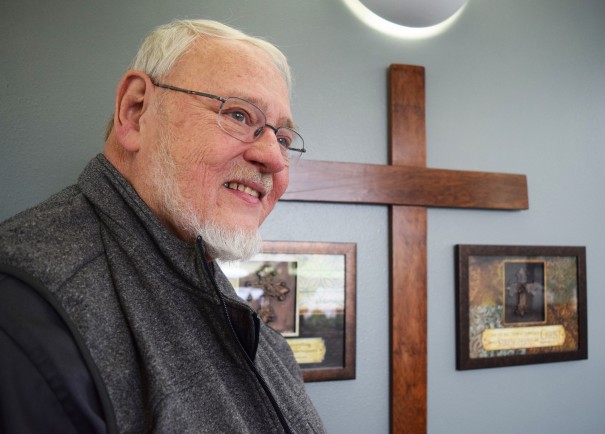
Retired pastor Dennis Bossman is living proof of the benefits of organ donation.
Twice.
The Brandon man is the recipient of two life-saving organ donations, a liver and a kidney, and because of those gifts, Bossman today is an ambassador promoting both organ donation and National Donor Sabbath.
National Donor Sabbath takes place Nov. 10-12, and its purpose for ambassadors, such as Bossman, is to share the importance of organ, eye and tissue donation and to encourage people to register as organ donors.
Long before Bossman was on the recipient side, he had already pledged to be an organ donor.
“I’ve been an organ donor for years,” Bossman said. “My brother, Kenneth, had a kidney transplant back in the ‘80s, and so I’m extremely familiar with transplant situation-purpose. His transplant lasted 13 years before he died. He ended up dying of a heart attack, but the week before he died he was told that his kidney was failing and he would have to be put back on dialysis, and he said, ‘No way, I am not going to go back on dialysis. I just can’t.’ He spent several days just praying to die. He did not want to go back on dialysis and the day before he was scheduled to go on dialysis, he died of a heart attack in the middle of the night.”
Bossman encourages people to put their fears aside about organ donation.
“I think most of the time people are frightened about the fact that, ‘Well, when I die, I don’t want my parts taken out of me.’ I distinctly remember when my mother died, and she died from the same liver failure that I have, thinking about if they did an autopsy – cut into the body - that seemed ‘not fun’ or proper,” he said. “It takes a while for a person to understand there is a difference between the physical body and the physical person. The body is the body, but the person is the soul within that body, and any time that any kind of intrusion in the physical body after death is not either harmful or distasteful when you accept the fact that there is so much good that comes from it.”
The good that comes from it is extensive. According to LifeSource, a nonprofit organization dedicated to saving lives through organ, eye and tissue donation in the Upper Midwest, a single donor can save and heal the lives of 75 people.
“When you realize how many people die waiting because there are not sufficient donated organs, I couldn’t help but be a severe ambassador to encourage people to please donate. Why go ahead and put absolutely good organs in the grave when they can do some good?”
Each day, 22 people die while waiting for a transplant, and regionally, 3,394 people are currently on the waiting the list, with the largest number – 2,581 – waiting for a kidney. Nationally, that number spikes to 116,329 people are on the waiting list, and again, kidney is at the top of the list, numbering 96,603. The liver is the second leading organ transplant need.
Bossman’s need for liver and kidney transplants dates back to Easter Sunday of 2012. Sick and disoriented, Bossman scheduled an appointment with Dr. Richard Briggs at Avera Medical Group McGreevy Brandon. Dr. Briggs recognized an ammonia buildup in his blood, and referred him to Dr. Mumatz Niazi, a hepatologist at Avera Medical Group Liver Disease Sioux Falls. Dr. Niazi determined Bossman had nonalcoholic steatohepatitis (NASH), or inflammation and damage to the liver due to fat buildup.
Kidney failure had also caused him to retain excess water, which then began the long process of removing dozens of pounds of fluid through inserted needles.
About this same time, a tumor was discovered in his liver. Because Bossman’s liver was so irreversibly damaged and his kidney failure left him looking toward an endless stream of dialysis sessions, physicians at Avera Transplant Institute knew he needed a transplant of both vital organs. So, when a liver and kidney match became available, his physicians scheduled the procedure at a Milwaukee medical center, which collaborates with Avera in liver transplant.
During his stay in Milwaukee from October 2013 to April 2014, Bossman encountered a number of health concerns, and like his brother years ago, was praying to die. “I wasn’t afraid to die, but I was ready to die,” he said. “I saw no hope so much of the time because I couldn’t walk anymore, I couldn’t talk, I couldn’t eat – it was, in my opinion, hopeless at the time.”
Bossman shared the emotional story of his eight-month hospital stay in a chapter of the recently-released anthology, Yes You Can! Go for Achieving Your Dreams:
“For eight months, I struggled in the hospital. The roller coaster ride was nearly unbearable. Eleven surgeries, six months in intensive care, bed-ridden, unable to walk, kidney and liver transplants, a collapsed lung, infections, feeding tubes, breathing tubes, a tracheostomy, and I was too weak to hold a pencil, which made communication impossible. There was one setback after another. I was filled with hope one day and then – poof - a critical setback. Three times the doctors thought they ‘lost me.'"
Bossman said he has some recollection of the complications.
“All was going along fine and I was starting to feel better and then all of a sudden, I had a heartburn and I thought, what’s going on,” he tells. “I was reaching to push the button to call the nurse and then it exploded and I had a fountain of blood that just poured out of my mouth. I put my hands up to stop it and I can still see all of that blood squirting out, dripping down my hands and down my elbows. I was screaming. I can still see several nurses come running to the door and then I passed out and I don’t remember anything then for I don’t how many days when I went into a coma.”
He addresses that in his chapter, too.
“My family and minister were called in and a lengthy discussion occurred. Do we continue on with life support systems or let God’s will be done? Though I was unaware of the situation, I was a part of that discussion. Just a week before that, I had signed a living will. I did not want to live connected to machines! Yet, at the time of the discussion I had such trouble breathing that I couldn’t think at all about death as a consequence. I could only think that a machine could help me breathe, and I wanted that help now.
“But infections set in. Septic shock. I could not survive. Hope is the thing with feathers; it flutters away and disappears. Time to reconsider unplugging the machine or to keep it going? I could not answer. I was in a coma. My son-in-law, Nathan, encouraged the doctors to ‘give it another day’.
“By morning, miraculously, I awakened. Faith is the assurance of things hoped for, and hope, if it is yours, will come back to you. And it did.”
In April 2014, Bossman was elated to return to his family and home in Brandon, and brought with him a new outlook on life. Months after his return home, Dr. Jeffrey Steers, a transplant surgeon at Avera Medical Group Transplant and Livery Surgery, asked Bossman, “Was it all worth it?”
“I admitted at the time when I got out (of the hospital), I think I would say ‘no,’ but now that I’m back to living well, I think it’s all worth it. I’ve often thought if somebody came up to me and said, ‘I have to have a transplant. What do you think? Should I go through with it?’ My answer would be ‘absolutely.’”
The donor remains a mystery to Bossman.
“I was told that only 18 percent of the recipients ever find out,” he said, adding that he writes a letter to the donor family about four times a year. The letters are filtered to the donor family through the hospital.
“The family has the choice to receive the letter or not and has the choice to write a response or not. As far as why they don’t respond, could be many reasons – maybe it still hurts, who knows why. It’s their option. I have a prayer that they still will someday, and I always will wonder, and again, I might be among the 18 percent that never hear,” he said.
As painful as it may be for the donor family, Bossman admits to early feelings of guilt.
“It’s a traumatic experience and it took me a long time to realize they would’ve died anyway,” Bossman said. “Somebody once asked me how I feel about having somebody else’s liver and somebody else’s kidney, and the only way I can respond to that is I don’t seem them anymore as somebody else’s kidney or liver because they’re not needing them anymore and they were given to me. If you get a Christmas present, whether it be a shirt or a tie or whatever, do you go around saying, ‘Look at this gift. It came from so and so, his tie, his shirt.’ No, no, it’s yours, it’s been given to you. So that business that its somebody else’s, no, it’s mine. If somebody gives you a gift, it’s yours, and praise the Lord that you get it.”
About organ donation in S.D.
• More than 121,000 Americans are waiting for a life-saving organ transplant.
• Every 10 minutes someone is added to the waiting list.
• Each day 22 men, women and children die in the U.S. due to the organ shortage.
• A single donor can save and heal the lives of 75 people.
• There is no cost to become an organ donor.
• In South Dakota, you can register to become an organ donor online, by mail, or in person at a Department of Motor Vehicles office.
• For more information, call (888) 5-DONATE or visit life-source.org.